AI Hiring Risk
AI Hiring Risk: What It Is and Why It Matters
AI hiring risk refers to the legal, technical, workforce, and operational exposure created when organizations use automated systems to screen, rank, assess, or make decisions about job candidates.
This includes tools such as:
AI resume screening and matching systems
Automated candidate ranking algorithms
Video interview and assessment AI
Personality and skills inference models
Large-scale applicant tracking systems with embedded automation
As AI becomes embedded across hiring workflows, small technical decisions can scale into systemic compliance failures. What looks like efficiency at low volume can quickly become regulatory risk at enterprise scale.

The Core Problem with AI in Hiring
AI Hiring Risk Is a Governance Problem
AI hiring risk cannot be managed through HR policy or vendor assurances alone. It requires coordinated governance across:
Legal risk — regulatory obligations and defensibility
Systems security — data protection and technical integrity
Workforce compliance — classification, vendor governance, and labor standards
Algorithmic behavior — model performance and bias patterns
Human oversight — accountability for automated decisions
Without alignment across these layers, organizations remain exposed even when individual controls appear compliant.
Most organizations adopt AI in hiring as a productivity upgrade. In reality, they are deploying regulated decision systems without the governance structures normally applied to financial, medical, or legal infrastructure.
The result is a growing set of risks:
Algorithmic bias and disparate impact
Lack of transparency in decision logic
Unclear accountability for automated decisions
Inconsistent human oversight
Inability to explain or defend outcomes
AI systems do not fail loudly. They fail quietly, at scale, and with human consequences.

How We Approach AI Hiring Risk
Wildfire Group AI Hiring Risk Advisory & Talent Strategy treats hiring systems as regulated decision infrastructure.
We assess AI hiring risk across four layers:
1. Data integrity
What data is used, where it comes from, and how it shapes outcomes.
2. Algorithmic behavior
How models actually perform, not how vendors describe them.
3. Human oversight
Where humans intervene, and where they do not.
4. Accountability systems
Who owns outcomes, and how decisions are documented and defended.
5. Systems security & workforce compliance
Evaluating data access, vendor risk, classification exposure, and technical vulnerabilities across hiring infrastructure.
This framework allows organizations to move from blind automation to governed decision-making.
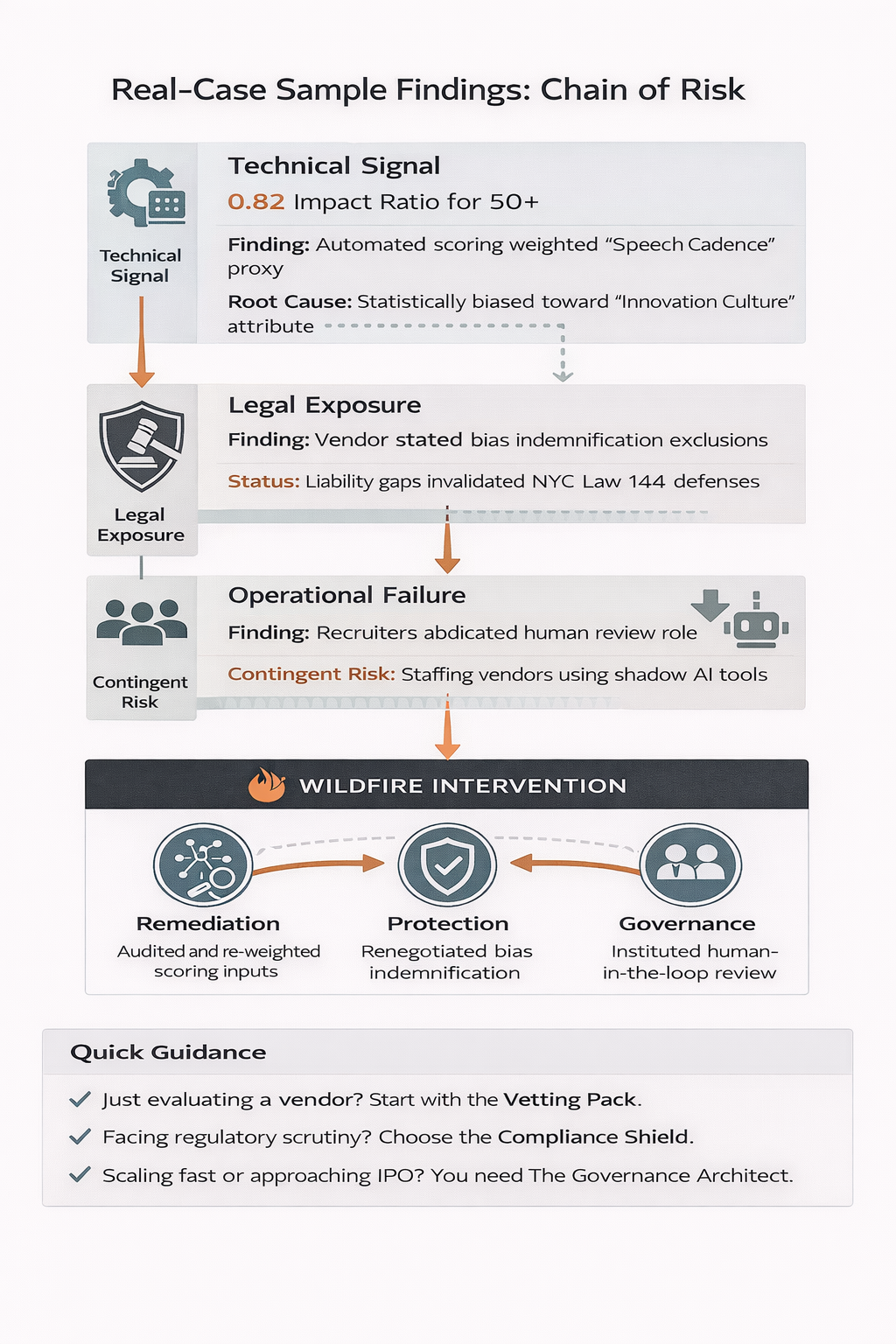
Wildfire High-Stakes Audit: What We Actually Find
Why AI Hiring Risk Is Increasing
AI hiring risk is accelerating for three reasons:
1. Regulatory pressure
Governments are no longer treating automated hiring as experimental technology. It is increasingly regulated under employment law, data protection frameworks, and emerging AI-specific legislation.
Organizations now face real exposure under:
EEOC guidance
NYC Local Law 144
State-level algorithmic accountability laws
EU AI Act and similar global frameworks
2. Tool sprawl
Most companies do not operate a single hiring system. They run layered stacks of ATS platforms, sourcing tools, assessment products, and vendor AI models with little unified governance.
Each tool introduces new data flows, new model behavior, and new compliance risk.
3. Scale effects
At high candidate volumes, even small model flaws become systemic. A 2% bias error becomes thousands of impacted candidates. A single logic flaw becomes an organizational pattern.
Common AI Hiring Failure Modes
We consistently see the same risk patterns across organizations:
Automated screening with no audit trail
Black-box vendor models with no explainability
Resume parsing systems trained on biased historical data
AI assessments with unclear validity
Human reviewers rubber-stamping automated outputs
No documented accountability for outcomes
Most failures are not malicious. They are structural.
What Makes AI Hiring Risk Different from Traditional HR Risk
Traditional HR risk is process-based.
AI hiring risk is systems-based.
The difference is critical.
In AI-driven hiring:
Decisions are distributed across machines and humans
Errors are difficult to detect without deliberate audits
Responsibility becomes fragmented across vendors, teams, and tools
Harm can occur without intent or visibility
This is not an HR problem.
It is a governance problem.


Next Step
Request an AI Hiring Risk Assessment
If your organization uses automated hiring systems, AI recruitment tools, or large-scale talent platforms, we can help you understand your exposure and design governance before problems scale.